MoreExam
1. Question Content...
EXPLANATION
Answer: X - EXPLANATION Content.
Question1: A project lead is reviewing the statement of work for an upcoming project that is focused on identifying potential weaknesses in the organization's internal and external network infrastructure. As part of the project, a team of external contractors will attempt to employ various attacks against the organization. The statement of work specifically addresses the utilization of an automated tool to probe network resources in an attempt to develop logical diagrams indication weaknesses in the infrastructure.The scope of activity as described in the statement of work is an example of:
Question2: A company that is hiring a penetration tester wants to exclude social engineering from the list of authorized activities. Which of the following documents should include these details?
Question3: A new policy requires the security team to perform web application and OS vulnerability scans. All of the company's web applications use federated authentication and are accessible via a central portal. Which of the following should be implemented to ensure a more thorough scan of the company's web application, while at the same time reducing false positives?
Question4: Which of the following stakeholders would need to be aware of an e-discovery notice received by the security office about an ongoing case within the manufacturing department?
Question5: Which of the following utilities could be used to resolve an IP address to a domain name, assuming the address has a PTR record?
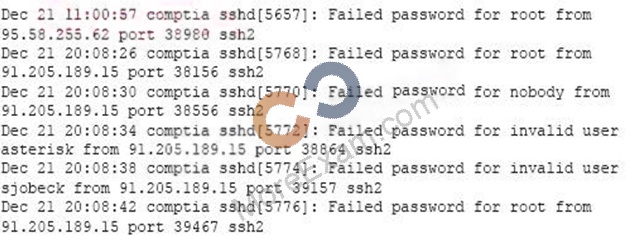
Question6: A security analyst is reviewing the following log after enabling key-based authentication.Given the above information, which of the following steps should be performed NEXT to secure the system?
Question7: A security analyst begins to notice the CPU utilization from a sinkhole has begun to spike. Which of the following describes what may be occurring?
Question8: A company decides to move three of its business applications to different outsourced cloud providers. After moving the applications, the users report the applications time out too quickly and too much time is spent logging back into the different web-based applications throughout the day. Which of the following should a security architect recommend to improve the end-user experience without lowering the security posture?
Question9: A database administrator contacts a security administrator to request firewall changes for a connection to a new internal application.The security administrator notices that the new application uses a port typically monopolized by a virus.The security administrator denies the request and suggests a new port or service be used to complete the application's task.Which of the following is the security administrator practicing in this example?
Question10: A production web server is experiencing performance issues. Upon investigation, new unauthorized applications have been installed and suspicious traffic was sent through an unused port. Endpoint security is not detecting any malware or virus. Which of the following types of threats would this MOST likely be classified as?
Question11: An analyst reviews a recent report of vulnerabilities on a company's financial application server. Which of the following should the analyst rate as being of the HIGHEST importance to the company's environment?
Question12: A cybersecurity analyst has received a report that multiple systems are experiencing slowness as a result of a DDoS attack. Which of the following would be the BEST action for the cybersecurity analyst to perform?
Question13: A security analyst is making recommendations for securing access to the new forensic workstation and workspace. Which of the following security measures should the analyst recommend to protect access to forensic data?
Question14: A security analyst is conducting a vulnerability assessment of older SCADA devices on the corporate network. Which of the following compensating controls is likely to prevent the scans from providing value?
Question15: A security analyst is reviewing packet captures to determine the extent of success during an attacker's reconnaissance phase following a recent incident.The following is a hex and ASCII dump of one such packet:Which of the following BEST describes this packet?
Question16: A security administrator has uncovered a covert channel used to exfiltrate confidential data from an internal database server through a compromised corporate web server. Ongoing exfiltration is accomplished by embedding a small amount of data extracted from the database into the metadata of images served by the web server. File timestamps suggest that the server was initially compromised six months ago using a common server misconfiguration. Which of the following BEST describes the type of threat being used?
Question17: A security analyst received several service tickets reporting that a company storefront website is not accessible by internal domain users. However, external users are accessing the website without issue.Which of the following is the MOST likely reason for this behavior?
Question18: A software development company in the manufacturing sector has just completed the alpha version of its flagship application. The application has been under development for the past three years. The SOC has seen intrusion attempts made by indicators associated with a particular APT. The company has a hot site location for COOP. Which of the following threats would most likely incur the BIGGEST economic impact for the company?
Question19: A SIEM analyst noticed a spike in activities from the guest wireless network to several electronic health record (EHR) systems. After further analysis, the analyst discovered that a large volume of data has been uploaded to a cloud provider in the last six months. Which of the following actions should the analyst do FIRST?
Question20: A security analyst is performing ongoing scanning and continuous monitoring of the corporate datacenter.Over time, these scans are repeatedly showing susceptibility to the same vulnerabilities and an increase in new vulnerabilities on a specific group of servers that are clustered to run the same application. Which of the following vulnerability management processes should be implemented?
Question21: A cybersecurity analyst has received the laptop of a user who recently left the company. The analyst types'history' into the prompt, and sees this line of code in the latest bash history:This concerns the analyst because this subnet should not be known to users within the company. Which of the following describes what this code has done on the network?
Question22: While reviewing web server logs, a security analyst notices the following code:Which of the following would prevent this code from performing malicious actions?
Question23: A cybersecurity analyst has several SIEM event logs to review for possible APT activity. The analyst was given several items that include lists of indicators for both IP addresses and domains. Which of the following actions is the BEST approach for the analyst to perform?
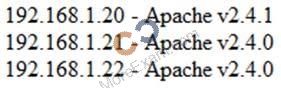
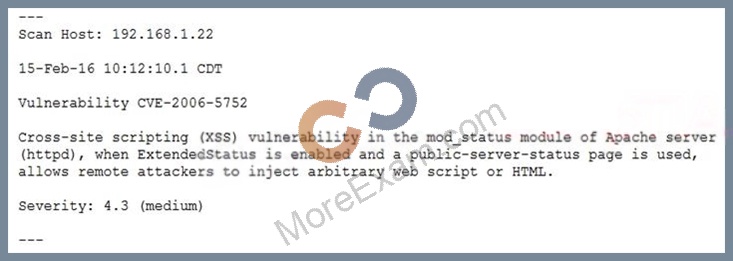
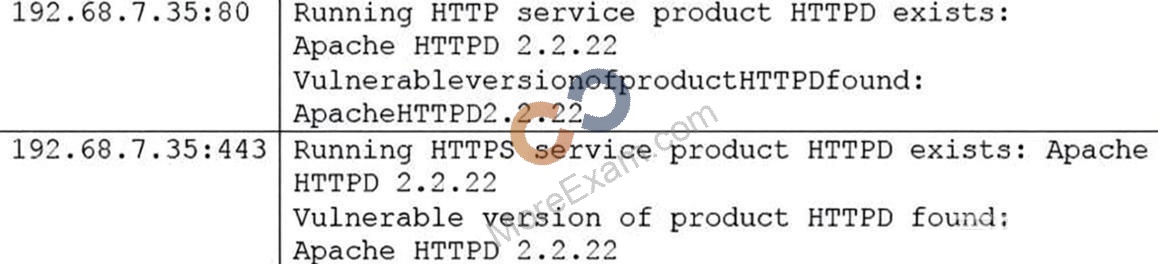
Question24: Organizational policies require vulnerability remediation on severity 7 or greater within one week. Anything with a severity less than 7 must be remediated within 30 days. The organization also requires security teams to investigate the details of a vulnerability before performing any remediation. If the investigation determines the finding is a false positive, no remediation is performed and the vulnerability scanner configuration is updates to omit the false positive from future scans:The organization has three Apache web servers:The results of a recent vulnerability scan are shown below:The team performs some investigation and finds a statement from Apache:Which of the following actions should the security team perform?
Question25: A malware infection spread to numerous workstations within the marketing department. The workstations were quarantined and replaced with machines.Which of the following represents a FINAL step in the eradication of the malware?
Question26: While a threat intelligence analyst was researching an indicator of compromise on a search engine, the web proxy generated an alert regarding the same indicator. The threat intelligence analyst states that related sites were not visited but were searched for in a search engine. Which of the following MOST likely happened in this situation?
Question27: During a web application vulnerability scan, it was discovered that the application would display inappropriate data after certain key phrases were entered into a webform connected to a SQL database server. Which of the following should be used to reduce the likelihood of this type of attack returning sensitive data?
Question28: A company allows employees to work remotely. The security administration is configuring services that will allow remote help desk personnel to work secure outside the company's headquarters. Which of the following presents the BEST solution to meet this goal?
Question29: A security analyst is making recommendations for securing access to the new forensic workstation and workspace. Which of the following security measures should the analyst recommend to protect access to forensic data?
Question30: A security analyst is making recommendations for securing access to the new forensic workstation and workspace. Which of the following security measures should the analyst recommend to protect access to forensic data?
Question31: While reviewing firewall logs, a security analyst at a military contractor notices a sharp rise in activity from a foreign domain known to have well-funded groups that specifically target the company's R&D department. Historical data reveals other corporate assets were previously targeted. This evidence MOST likely describes:
Question32: A recent audit included a vulnerability scan that found critical patches released 60 days prior were not applied to servers in the environment. The infrastructure team was able to isolate the issue and determined it was due to a service being disabled on the server running the automated patch management application.Which of the following would be the MOST efficient way to avoid similar audit findings in the future?
Question33: The primary difference in concern between remediating identified vulnerabilities found in general-purpose IT network servers and that of SCADA systems is that:
Question34: A recent audit has uncovered several coding errors and a lack of input validation being used on a public portal. Due to the nature of the portal and the severity of the errors, the portal is unable to be patched.Which of the following tools could be used to reduce the risk of being compromised?
Question35: A security analyst notices PII has been copied from the customer database to an anonymous FTP server in the DMZ. Firewall logs indicate the customer database has not been accessed from anonymous FTP server. Which of the following departments should make a decision about pursuing further investigation?(Choose two.)
Question36: A security analyst is making recommendations for securing access to the new forensic workstation and workspace. Which of the following security measures should the analyst recommend to protect access to forensic data?
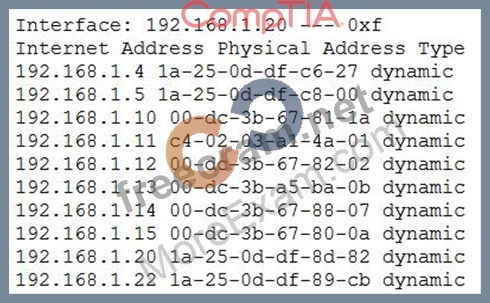
Question37: A company installed a wireless network more than a year ago, standardizing on the same model APs in a single subnet. Recently, several users have reported timeouts and connection issues with Internet browsing. The security administrator has gathered some information about the network to try to recreate the issues with the assistance of a user. The administrator is able to ping every device on the network and confirms that the network is very slow.Output:Given the above results, which of the following should the administrator investigate FIRST?
Question38: A security audit revealed that port 389 has been used instead of 636 when connecting to LDAP for the authentication of users. The remediation recommended by the audit was to switch the port to 636 wherever technically possible. Which of the following is the BEST response?
Question39: A security analyst has noticed an alert from the SIEM. A workstation is repeatedly trying to connect to port445 of a file server on the production network. All of the attempts are made with invalid credentials. Which of the following describes what is occurring?
Question40: An analyst is troubleshooting a PC that is experiencing high processor and memory consumption.Investigation reveals the following processes are running on the system:lsass.execsrss.exewordpad.exenotepad.exeWhich of the following tools should the analyst utilize to determine the rogue process?
Question41: An insurance company employs quick-response team drivers that carry corporate-issued mobile devices with the insurance company's app installed on them. Devices are configuration-hardened by an MDM and kept up to date. The employees use the app to collect insurance claim information and process payments.Recently, a number of customers have filed complaints of credit card fraud against the insurance company, which occurred shortly after their payments were processed via the mobile app. The cyber-incident response team has been asked to investigate. Which of the following is MOST likely the cause?
Question42: A pharmacy gives its clients online access to their records and the ability to review bills and make payments. A new SSL vulnerability on a special platform was discovered, allowing an attacker to capture the data between the end user and the web server providing these services. After investigating the platform vulnerability, it was determined that the web services provided are being impacted by this new threat.Which of the following data types are MOST likely at risk of exposure based on this new threat? (Choose two.)
Question43: Which of the following countermeasures should the security administrator apply to MOST effectively mitigate Bootkit-level infections of the organization's workstation devices?
Question44: The Chief Information Security Officer (CISO) has asked the security staff to identify a framework on which to base the security program. The CISO would like to achieve a certification showing the security program meets all required best practices. Which of the following would be the BEST choice?
Question45: A security analyst is making recommendations for securing access to the new forensic workstation and workspace. Which of the following security measures should the analyst recommend to protect access to forensic data?
Question46: The security operations team is conducting a mock forensics investigation. Which of the following should be the FIRST action taken after seizing a compromised workstation?
Question47: Which of the following represent the reasoning behind careful selection of the timelines and time-of-day boundaries for an authorized penetration test? (Select TWO).
Question48: Which of the following best practices is used to identify areas in the network that may be vulnerable to penetration testing from known external sources?
Question49: In order to leverage the power of data correlation within Nessus, a cybersecurity analyst needs to write an SQL statement that will provide how long a vulnerability has been present on the network.Given the following output table:Which of the following SQL statements would provide the resulted output needed for this correlation?
Question50: A company has decided to process credit card transactions directly. Which of the following would meet the requirements for scanning this type of data?
Question51: An organization wants to harden its web servers. As part of this goal, leadership has directed that vulnerability scans be performed, and the security team should remediate the servers according to industry best practices. The team has already chosen a vulnerability scanner and performed the necessary scans, and now the team needs to prioritize the fixes. Which of the following would help to prioritize the vulnerabilities for remediation in accordance with industry best practices?
Question52: While preparing for a third-party audit, the vice president of risk management and the vice president of information technology have stipulated that the vendor may not use offensive software during the audit.This is an example of:
Question53: External users are reporting that a web application is slow and frequently times out when attempting to submit information. Which of the following software development best practices would have helped prevent this issue?
Question54: An analyst is preparing for a technical security compliance check on all Apache servers. Which of the following will be the BEST to use?
Question55: A cybersecurity analyst wants to use ICMP ECHO_REQUESTon a machine while using Nmap. Which of the following is the correct command to accomplish this?
Question56: Which of the following is a vulnerability when using Windows as a host OS for virtual machines?
Question57: A company provides wireless connectivity to the internal network from all physical locations for company- owned devices. Users were able to connect the day before, but now all users have reported that when they connect to an access point in the conference room, they cannot access company resources. Which of the following BEST describes the cause of the problem?
Question58: A computer has been infected with a virus and is sending out a beacon to command and control server through an unknown service. Which of the following should a security technician implement to drop the traffic going to the command and control server and still be able to identify the infected host through firewall logs?
Question59: File integrity monitoring states the following files have been changed without a written request or approved change. The following change has been made:chmod 777 -Rv /usrWhich of the following may be occurring?
Question60: A security analyst has determined the security team should take action based on the following log:Which of the following should be used to improve the security posture of the system?
Question61: A company's asset management software has been discovering a weekly increase in non-standard software installed on end users' machines with duplicate license keys. The security analyst wants to know if any of this software is listening on any non-standard ports, such as 6667. Which of the following tools should the analyst recommend to block any command and control traffic?
Question62: In order to the leverage the power of data correlation with Nessus, a cybersecurity analyst must first be able to create a table for the scan results.Given the following snippet of code:Which of the following output items would be correct?A:B:C:D:
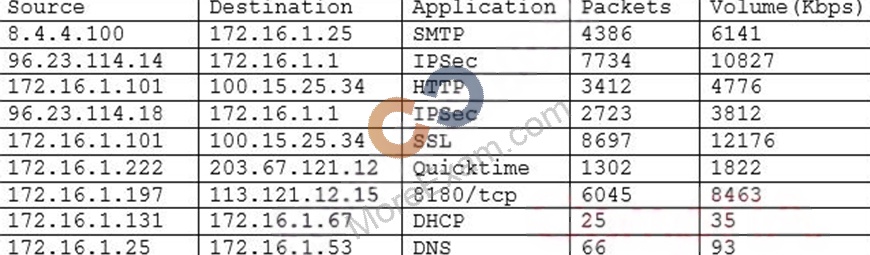
Question63: A security analyst is reviewing a report from the networking department that describes an increase in network utilization, which is causing network performance issues on some systems. A top talkers report over a five-minute sample is included.Given the above output of the sample, which of the following should the security analyst accomplish FIRST to help track down the performance issues?
Question64: A security analyst is adding input to the incident response communication plan. A company officer has suggested that if a data breach occurs, only affected parties should be notified to keep an incident from becoming a media headline. Which of the following should the analyst recommend to the company officer?
Question65: Creating an isolated environment in order to test and observe the behavior of unknown software is also known as:
Question66: An executive tasked a security analyst to aggregate past logs, traffic, and alerts on a particular attack vector. The analyst was then tasked with analyzing the data and making predictions on future complications regarding this attack vector. Which of the following types of analysis is the security analyst MOST likely conducting?
Question67: Due to new regulations, a company has decided to institute an organizational vulnerability management program and assign the function to the security team. Which of the following frameworks would BEST support the program? (Select two.)
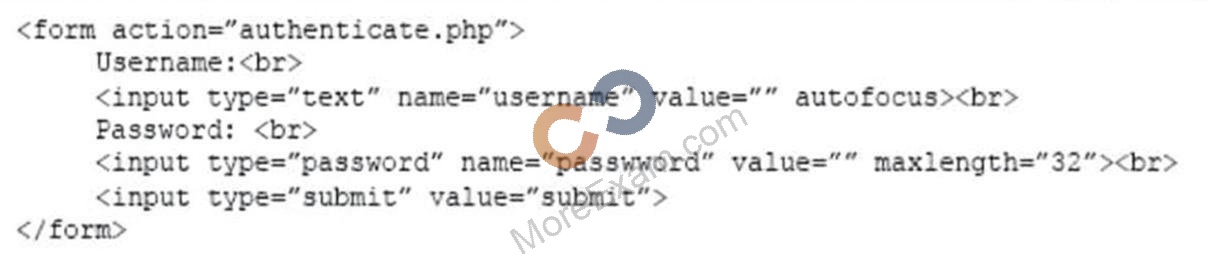
Question68: After scanning the main company's website with the OWASP ZAP tool, a cybersecurity analyst is reviewing the following warning:The analyst reviews a snippet of the offending code:Which of the following is the BEST course of action based on the above warning and code snippet?
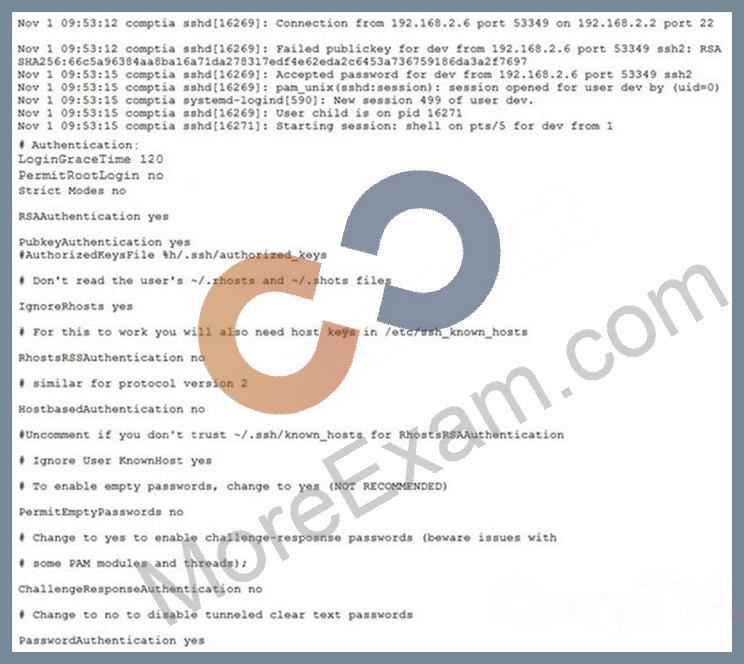
Question69: Company A's security policy states that only PKI authentication should be used for all SSH accounts. A security analyst from Company A is reviewing the following auth.log and configuration settings:Which of the following changes should be made to the following sshd_config file to establish compliance with the policy?
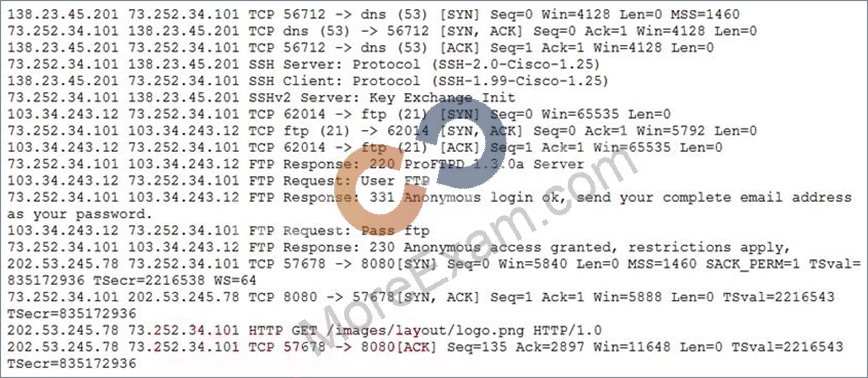
Question70: A security analyst is reviewing packet captures for a specific server that is suspected of containing malware and discovers the following packets:Which of the following traffic patterns or data would be MOST concerning to the security analyst?
Question71: While reviewing three months of logs, a security analyst notices probes from random company laptops going to SCADA equipment at the company's manufacturing location. Some of the probes are getting responses from the equipment even though firewall rules are in place, which should block this type of unauthorized activity. Which of the following should the analyst recommend to keep this activity from originating from company laptops?
Question72: Which of the following organizations would have to remediate embedded controller vulnerabilities?
Question73: A security analyst is concerned that unauthorized users can access confidential data stored in the production server environment. All workstations on a particular network segment have full access to any server in production. Which of the following should be deployed in the production environment to prevent unauthorized access? (Choose two.)
Question74: Which of the following is MOST effective for correlation analysis by log for threat management?
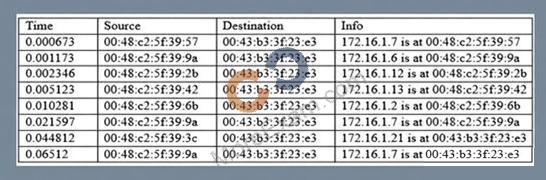
Question75: After running a packet analyzer on the network, a security analyst has noticed the following output:Which of the following is occurring?
Question76: A security analyst has created an image of a drive from an incident. Which of the following describes what the analyst should do NEXT?
Question77: Which of the following policies BEST explains the purpose of a data ownership policy?
Question78: A cybersecurity analyst is completing an organization's vulnerability report and wants it to reflect assets accurately. Which of the following items should be in the report?
Question79: An organization wants to remediate vulnerabilities associated with its web servers. An initial vulnerability scan has been performed, and analysts are reviewing the results. Before starting any remediation, the analysts want to remove false positives to avoid spending time on issues that are not actual vulnerabilities.Which of the following would be an indicator of a likely false positive?
Question80: Which of the following commands would a security analyst use to make a copy of an image for forensics use?
Question81: A security analyst is making recommendations for securing access to the new forensic workstation and workspace. Which of the following security measures should the analyst recommend to protect access to forensic data?
Question82: A cybersecurity analyst was asked to discover the hardware address of 30 networked assets. From a command line, which of the following tools would be used to provide ARP scanning and reflects the MOST efficient method for accomplishing the task?
Question83: A company has several internal-only, web-based applications on the internal network. Remote employees are allowed to connect to the internal corporate network with a company-supplied VPN client. During a project to upgrade the internal application, contractors were hired to work on a database server and were given copies of the VPN client so they could work remotely. A week later, a security analyst discovered an internal web-server had been compromised by malware that originated from one of the contractor's laptops. Which of the following changes should be made to BEST counter the threat presented in this scenario?
Question84: A security analyst with an international response team is working to isolate a worldwide distribution of ransomware. The analyst is working with international governing bodies to distribute advanced intrusion detection routines for this variant of ransomware. Which of the following is the MOST important step with which the security analyst should comply?
Question85: Law enforcement has contacted a corporation's legal counsel because correlated data from a breach shows the organization as the common denominator from all indicators of compromise. An employee overhears the conversation between legal counsel and law enforcement, and then posts a comment about it on social media. The media then starts contacting other employees about the breach. Which of the following steps should be taken to prevent further disclosure of information about the breach?
Question86: After completing a vulnerability scan, the following output was noted:Which of the following vulnerabilities has been identified?
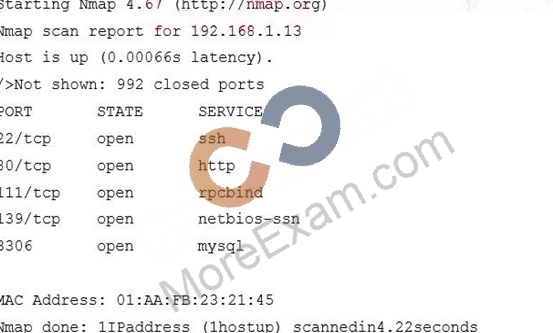
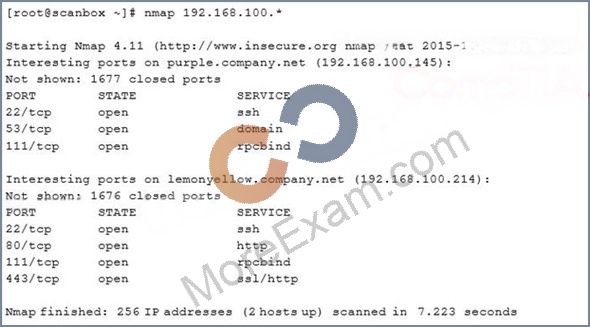
Question87: An organization has a policy prohibiting remote administration of servers where web services are running.One of the Nmap scans is shown here:Given the organization's policy, which of the following services should be disabled on this server?
Question88: A network administrator is attempting to troubleshoot an issue regarding certificates on a secure website.During the troubleshooting process, the network administrator notices that the web gateway proxy on the local network has signed all of the certificates on the local machine.Which of the following describes the type of attack the proxy has been legitimately programmed to perform?
Question89: An HR employee began having issues with a device becoming unresponsive after attempting to open an email attachment. When informed, the security analyst became suspicious of the situation, even though there was not any unusual behavior on the IDS or any alerts from the antivirus software. Which of the following BEST describes the type of threat in this situation?
Question90: A nuclear facility manager determined the need to monitor utilization of water within the facility. A startup company just announced a state-of-the-art solution to address the need for integrating the business and ICS network. The solution requires a very small agent to be installed on the ICS equipment. Which of the following is the MOST important security control for the manager to invest in to protect the facility?
Question91: During a routine review of firewall logs, an analyst identified that an IP address from the organization's server subnet had been connecting during nighttime hours to a foreign IP address, and had been sending between 150 and 500 megabytes of data each time. This had been going on for approximately one week, and the affected server was taken offline for forensic review. Which of the following is MOST likely to drive up the incident's impact assessment?
Question92: In order to meet regulatory compliance objectives for the storage of PHI, vulnerability scans must be conducted on a continuous basis. The last completed scan of the network returned 5,682 possible vulnerabilities. The Chief Information Officer (CIO) would like to establish a remediation plan to resolve all known issues. Which of the following is the BEST way to proceed?
Question93: A business-critical application is unable to support the requirements in the current password policy because it does not allow the use of special characters. Management does not want to accept the risk of a possible security incident due to weak password standards. Which of the following is an appropriate means to limit the risks related to the application?
Question94: An organization is experiencing degradation of critical services and availability of critical external resources. Which of the following can be used to investigate the issue?
Question95: A security analyst was asked to join an outage call for a critical web application. The web middleware support team determined the web server is running and having no trouble processing requests; however, some investigation has revealed firewall denies to the web server that began around 1.00 a.m. that morning. An emergency change was made to enable the access, but management has asked for a root cause determination. Which of the following would be the BEST next step?
Question96: A security analyst has noticed that a particular server has consumed over 1TB of bandwidth over the course of the month. It has port 3333 open; however, there have not been any alerts or notices regarding the server or its activities. Which of the following did the analyst discover?
Question97: The help desk informed a security analyst of a trend that is beginning to develop regarding a suspicious email that has been reported by multiple users. The analyst has determined the email includes an attachment named invoice.zip that contains the following files:Locky.jsxerty.inixerty.libFurther analysis indicates that when the .zip file is opened, it is installing a new version of ransomware on the devices. Which of the following should be done FIRST to prevent data on the company NAS from being encrypted by infected devices?
Question98: Which of the following principles describes how a security analyst should communicate during an incident?
Question99: The director of software development is concerned with recent web application security incidents, including the successful breach of a back-end database server. The director would like to work with the security team to implement a standardized way to design, build, and test web applications and the services that support them. Which of the following meets the criteria?
Question100: A technician receives a report that a user's workstation is experiencing no network connectivity. The technician investigates and notices the patch cable running the back of the user's VoIP phone is routed directly under the rolling chair and has been smashed flat over time.Which of the following is the most likely cause of this issue?
Question101: While conducting research on malicious domains, a threat intelligence analyst received a blue screen of death. The analyst rebooted and received a message stating that the computer had been locked and could only be opened by following the instructions on the screen. Which of the following combinations describes the MOST likely threat and the PRIMARY mitigation for the threat?
Question102: An analyst was testing the latest version of an internally developed CRM system. The analyst created a basic user account. Using a few tools in Kali's latest distribution, the analyst was able to access configuration files, change permissions on folders and groups, and delete and create new system objects.Which of the following techniques did the analyst use to perform these unauthorized activities?
Question103: A company's computer was recently infected with ransomware. After encrypting all documents, the malware logs a random AES-128 encryption key and associated unique identifier onto a compromised remote website. A ransomware code snippet is shown below:Based on the information from the code snippet, which of the following is the BEST way for a cybersecurity professional to monitor for the same malware in the future?
Question104: A Linux-based file encryption malware was recently discovered in the wild. Prior to running the malware on a preconfigured sandbox to analyze its behavior, a security professional executes the following command:umount -a -t cifs,nfsWhich of the following is the main reason for executing the above command?
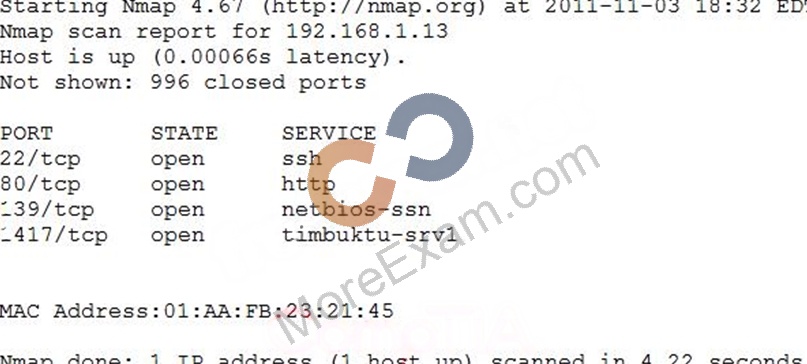
Question105: An organization is conducting penetration testing to identify possible network vulnerabilities. The penetration tester has received the following output from the latest scan:The penetration tester knows the organization does not use Timbuktu servers and wants to have Nmap interrogate the ports on the target in more detail. Which of the following commands should the penetration tester use NEXT?
Question106: A security analyst is reviewing IDS logs and notices the following entry:Which of the following attacks is occurring?
Question107: The security configuration management policy states that all patches must undergo testing procedures before being moved into production. The security analyst notices a single web application server has been downloading and applying patches during non-business hours without testing. There are no apparent adverse reactions, server functionality does not seem to be affected, and no malware was found after a scan.Which of the following actions should the analyst take?
Question108: An application development company released a new version of its software to the public. A few days after the release, the company is notified by end users that the application is notably slower, and older security bugs have reappeared in the new release. The development team has decided to include the security analyst during their next development cycle to help address the reported issues. Which of the following should the security analyst focus on to remedy the existing reported problems?
Question109: A security incident has been created after noticing unusual behavior from a Windows domain controller.The server administrator has discovered that a user logged in to the server with elevated permissions, but the user's account does not follow the standard corporate naming scheme. There are also several other accounts in the administrators group that do not follow this naming scheme. Which of the following is the possible cause for this behavior and the BEST remediation step?
Question110: While reviewing proxy logs, the security analyst noticed a suspicious traffic pattern. Several internal hosts were observed communicating with an external IP address over port 80 constantly. An incident was declared, and an investigation was launched. After interviewing the affected users, the analyst determined the activity started right after deploying a new graphic design suite. Based on this information, which of the following actions would be the appropriate NEXT step in the investigation?
Question111: A security analyst received a compromised workstation. The workstation's hard drive may contain evidence of criminal activities. Which of the following is the FIRST thing the analyst must do to ensure the integrity of the hard drive while performing the analysis?
Question112: A company has received the results of an external vulnerability scan from its approved scanning vendor.The company is required to remediate these vulnerabilities for clients within 72 hours of acknowledgement of the scan results.Which of the following contract breaches would result if this remediation is not provided for clients within the time frame?
Question113: After implementing and running an automated patching tool, a security administrator ran a vulnerability scan that reported no missing patches found. Which of the following BEST describes why this tool was used?
Question114: A list of vulnerabilities has been reported in a company's most recent scan of a server. The security analyst must review the vulnerabilities and decide which ones should be remediated in the next change window and which ones can wait or may not need patching. Pending further investigation. Which of the following vulnerabilities should the analyst remediate FIRST?
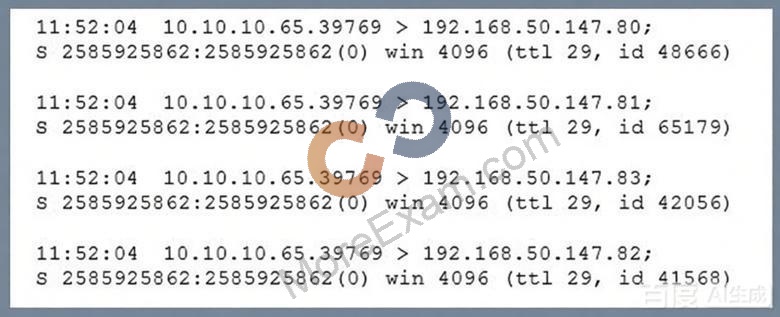
Question115: Given a packet capture of the following scan:Which of the following should MOST likely be inferred on the scan's output?
Question116: A cybersecurity analyst is reviewing the following outputs:Which of the following can the analyst infer from the above output?
Question117: A cybersecurity analyst is reviewing the current BYOD security posture. The users must be able to synchronize their calendars, email, and contacts to a smartphone or other personal device. The recommendation must provide the most flexibility to users. Which of the following recommendations would meet both the mobile data protection efforts and the business requirements described in this scenario?
Question118: Which of the following are essential components within the rules of engagement for a penetration test?(Select TWO).
Question119: NOTE: Question IP must be 192.168.192.123During a network reconnaissance engagement, a penetration tester was given perimeter firewall ACLs to accelerate the scanning process. The penetration tester has decided to concentrate on trying to brute force log in to destination IP address 192.168.192.132 via secure shell.Given a source IP address of 10.10.10.30, which of the following ACLs will permit this access?A:B:C:D:
Question120: After analyzing and correlating activity from multiple sensors, the security analyst has determined a group from a high-risk country is responsible for a sophisticated breach of the company network and continuous administration of targeted attacks for the past three months. Until now, the attacks went unnoticed. This is an example of:
Question121: When network administrators observe an increased amount of web traffic without an increased number of financial transactions, the company is MOST likely experiencing which of the following attacks?
Question122: A cybersecurity consultant found common vulnerabilities across the following services used by multiple servers at an organization: VPN, SSH, and HTTPS. Which of the following is the MOST likely reason for the discovered vulnerabilities?
Question123: A security analyst is performing a review of Active Directory and discovers two new user accounts in the accounting department. Neither of the users has elevated permissions, but accounts in the group are given access to the company's sensitive financial management application by default. Which of the following is the BEST course of action?
Question124: After reading about data breaches at a competing company, senior leaders in an organization have grown increasingly concerned about social engineering attacks. They want to increase awareness among staff regarding this threat, but do not want to use traditional training methods because they regard these methods as ineffective. Which of the following approaches would BEST meet the requirements?
Question125: A security analyst has determined that the user interface on an embedded device is vulnerable to common SQL injections. The device is unable to be replaced, and the software cannot be upgraded. Which of the following should the security analyst recommend to add additional security to this device?
Question126: An employee at an insurance company is processing claims that include patient addresses, clinic visits, diagnosis information, and prescription. While forwarding documentation to the supervisor, the employee accidentally sends the data to a personal email address outside of the company due to a typo. Which of the following types of data has been compromised?
Question127: Following a recent security breach, a post-mortem was done to analyze the driving factors behind the breach. The cybersecurity analysis discussed potential impacts, mitigations, and remediations based on current events and emerging threat vectors tailored to specific stakeholders. Which of the following is this considered to be?
Question128: An analyst is observing unusual network traffic from a workstation. The workstation is communicating with a known malicious site over an encrypted tunnel. A full antivirus scan with an updated antivirus signature file does not show any sign of infection. Which of the following has occurred on the workstation?
Question129: A penetration tester is preparing for an audit of critical systems that may impact the security of the environment. This includes the external perimeter and the internal perimeter of the environment. During which of the following processes is this type of information normally gathered?
Question130: A system administrator has reviewed the following output:Which of the following can a system administrator infer from the above output?
Question131: A cybersecurity analyst is reviewing Apache logs on a web server and finds that some logs are missing.The analyst has identified that the systems administrator accidentally deleted some log files. Which of the following actions or rules should be implemented to prevent this incident from reoccurring?
Question132: An analyst wants to use a command line tool to identify open ports and running services on a host along with the application that is associated with those services and port. Which of the following should the analyst use?
Question133: A technician receives the following security alert from the firewall's automated system:After reviewing the alert, which of the following is the BEST analysis?
Question134: Given the following output from a Linux machine:file2cable -i eth0 -f file.pcapWhich of the following BEST describes what a security analyst is trying to accomplish?
Question135: The development team currently consists of three developers who each specialize in a specific programming language:Developer 1 - C++/C#Developer 2 - PythonDeveloper 3 - AssemblyWhich of the following SDLC best practices would be challenging to implement with the current available staff?
Question136: On which of the following organizational resources is the lack of an enabled password or PIN a common vulnerability?
Question137: Which of the following systems would be at the GREATEST risk of compromise if found to have an open vulnerability associated with perfect forward secrecy?
Question138: A logistics company's vulnerability scan identifies the following vulnerabilities on Internet-facing devices in the DMZ:SQL injection on an infrequently used web server that provides files to vendorsSSL/TLS not used for a website that contains promotional informationThe scan also shows the following vulnerabilities on internal resources:Microsoft Office Remote Code Execution on test server for a human resources systemTLS downgrade vulnerability on a server in a development networkIn order of risk, which of the following should be patched FIRST?
Question139: In an effort to be proactive, an analyst has run an assessment against a sample workstation before auditors visit next month. The scan results are as follows:Based on the output of the scan, which of the following is the BEST answer?
Question140: Which of the following is a technology used to provide Internet access to internal associates without exposing the Internet directly to the associates?
Question141: A security analyst is preparing for the company's upcoming audit. Upon review of the company's latest vulnerability scan, the security analyst finds the following open issues:Which of the following vulnerabilities should be prioritized for remediation FIRST?
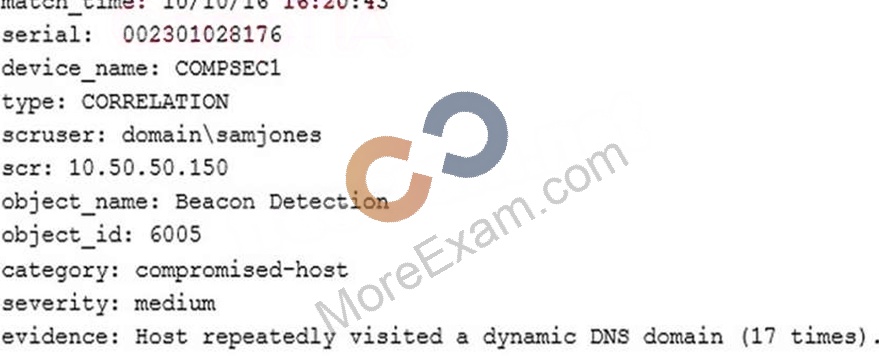
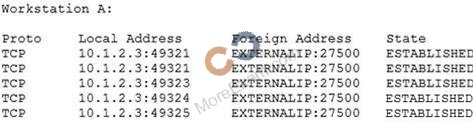
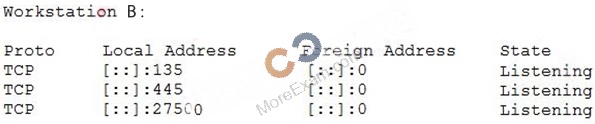
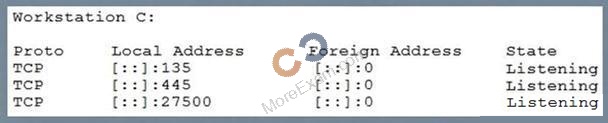
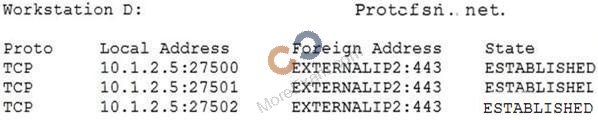
Question142: A newly discovered malware has a known behavior of connecting outbound to an external destination on port 27500 for the purposes of exfiltrating data. The following are four snippets taken from running netstat -anon separate Windows workstations:Based on the above information, which of the following is MOST likely to be exposed to this malware?
Question143: A security analyst has been asked to scan a subnet. During the scan, the following output was generated:Based on the output above, which of the following is MOST likely?
Question144: A technician is running an intensive vulnerability scan to detect which ports are open to exploit. During the scan, several network services are disabled and production is affected. Which of the following sources would be used to evaluate which network service was interrupted?
Question145: A vulnerability scan returned the following results for a web server that hosts multiple wiki sites:Apache-HTTPD-cve-2014-023: Apache HTTPD: mod_cgid denial of service CVE-2014-0231Due to a flaw found in mog_cgid, a server using mod_cgid to host CGI scripts could be vulnerable to a DoS attack caused by a remote attacker who is exploiting a weakness in non-standard input, causing processes to hang indefinitely.The security analyst has confirmed the server hosts standard CGI scripts for the wiki sites, does not have mod_cgid installed, is running Apache 2.2.22, and is not behind a WAF. The server is located in the DMZ, and the purpose of the server is to allow customers to add entries into a publicly accessible database.Which of the following would be the MOST efficient way to address this finding?
Question146: Alerts have been received from the SIEM, indicating infections on multiple computers. Based on threat characteristics, these files were quarantined by the host-based antivirus program. At the same time, additional alerts in the SIEM show multiple blocked URLs from the address of the infected computers; the URLs were classified as uncategorized. The domain location of the IP address of the URLs that were blocked is checked, and it is registered to an ISP in Russia. Which of the following steps should be taken NEXT?
Question147: A cybersecurity professional typed in a URL and discovered the admin panel for the e-commerce application is accessible over the open web with the default password. Which of the following is the MOST secure solution to remediate this vulnerability?
Question148: A security operations team was alerted to abnormal DNS activity coming from a user's machine. The team performed a forensic investigation and discovered a host had been compromised. Malicious code was using DNS as a tunnel to extract data from the client machine, which had been leaked and transferred to an unsecure public Internet site. Which of the following BEST describes the attack?
Question149: The business has been informed of a suspected breach of customer data. The internal audit team, in conjunction with the legal department, has begun working with the cybersecurity team to validate the report. To which of the following response processes should the business adhere during the investigation?
Question150: A software patch has been released to remove vulnerabilities from company's software. A security analyst has been tasked with testing the software to ensure the vulnerabilities have been remediated and the application is still functioning properly. Which of the following tests should be performed NEXT?
Question151: A cybersecurity analyst is conducting packet analysis on the following:Which of the following is occurring in the given packet capture?
Question152: A vulnerability analyst needs to identify all systems with unauthorized web servers on the 10.1.1.0/24 network. The analyst uses the following default Nmap scan:nmap -sV -p 1-65535 10.1.1.0/24Which of the following would be the result of running the above command?
Question153: A security analyst is making recommendations for securing access to the new forensic workstation and workspace. Which of the following security measures should the analyst recommend to protect access to forensic data?
Question154: A security analyst is reviewing output from a CVE-based vulnerability scanner. Before conducting the scan, the analyst was careful to select only Windows-based servers in a specific datacenter. The scan revealed that the datacenter includes 27 machines running Windows 2003 Server Edition (Win2003SE). In 2015, there were 36 new vulnerabilities discovered in the Win2003SE environment. Which of the following statements are MOST likely applicable? (Choose two.)
Question155: A threat intelligence feed has posted an alert stating there is a critical vulnerability in the kernel.Unfortunately, the company's asset inventory is not current. Which of the following techniques would a cybersecurity analyst perform to find all affected servers within an organization?
Question156: A cyber incident response team finds a vulnerability on a company website that allowed an attacker to inject malicious code into its web application. There have been numerous unsuspecting users visiting the infected page, and the malicious code executed on the victim's browser has led to stolen cookies, hijacked sessions, malware execution, and bypassed access control. Which of the following exploits is the attacker conducting on the company's website?
Question157: A security analyst has discovered that an outbound SFTP process is occurring at the same time of day for the past several days. At the time this was discovered, large amounts of business critical data were delivered. The authentication for this process occurred using a service account with proper credentials.The security analyst investigated the destination IP for this transfer and discovered that this new process is not documented in the change management log. Which of the following would be the BEST course of action for the analyst to take?
Question158: A cybersecurity analyst traced the source of an attack to compromised user credentials. Log analysis revealed that the attacker successfully authenticated from an unauthorized foreign country. Management asked the security analyst to research and implement a solution to help mitigate attacks based on compromised passwords. Which of the following should the analyst implement?
Question159: An analyst finds that unpatched servers have undetected vulnerabilities because the vulnerability scanner does not have the latest set of signatures. Management directed the security team to have personnel update the scanners with the latest signatures at least 24 hours before conducting any scans, but the outcome is unchanged. Which of the following is the BEST logical control to address the failure?
Question160: A cybersecurity analyst has received an alert that well-known "call home" messages are continuously observed by network sensors at the network boundary. The proxy firewall successfully drops the messages. After determining the alert was a true positive, which of the following represents the MOST likely cause?
Question161: Joe, an analyst, has received notice that a vendor who is coming in for a presentation will require access to a server outside the network. Currently, users are only able to access remote sites through a VPN connection. Which of the following should Joe use to BEST accommodate the vendor?
Question162: A company has implemented WPA2, a 20-character minimum for the WiFi passphrase, and a new WiFi passphrase every 30 days, and has disabled SSID broadcast on all wireless access points. Which of the following is the company trying to mitigate?
Question163: Which of the following could be directly impacted by an unpatched vulnerability in vSphere ESXi?
Question164: A systems administrator is trying to secure a critical system. The administrator has placed the system behind a firewall, enabled strong authentication, and required all administrators of this system to attend mandatory training.Which of the following BEST describes the control being implemented?
Question165: A security analyst has just completed a vulnerability scan of servers that support a business critical application that is managed by an outside vendor. The results of the scan indicate the devices are missing critical patches. Which of the following factors can inhibit remediation of these vulnerabilities? (Choose two.)
Question166: A company invested ten percent of its entire annual budget in security technologies. The Chief Information Officer (CIO) is convinced that, without this investment, the company will risk being the next victim of the same cyber attack its competitor experienced three months ago. However, despite this investment, users are sharing their usernames and passwords with their coworkers to get their jobs done. Which of the following will eliminate the risk introduced by this practice?